


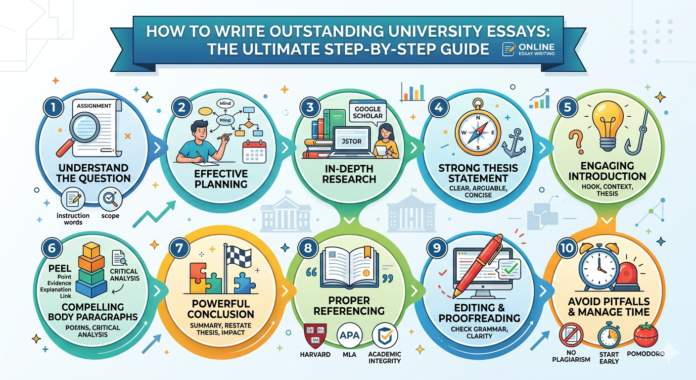
How to Write Outstanding University Essays: The Ultimate Step-by-Step Guide
Writing university essays is one of the most important skills you will develop during your academic journey. Whether you are a first-year undergraduate feeling overwhelmed by your first 2,000-word assignment or a final-year student aiming for a distinction, the ability to produce clear, well-researched, and persuasively argued essays can transform your grades and boost your confidence. Many students struggle not because they lack intelligence but because they have never been shown a reliable, repeatable process. This complete guide changes that. It takes you through every single stage of essay writing—from the moment you receive the assignment brief to the final polished draft—giving you practical strategies, real examples, and insider tips that you can apply immediately.
At Online Essay Writing, we have helped thousands of students master this process. While we offer professional essay writing support when deadlines feel impossible, the goal of this guide is to empower you to write outstanding essays on your own. Follow these steps consistently and you will notice your marks improve dramatically. Let’s begin.
Understanding the Essay Question Thoroughly
The most common reason students lose marks is that they answer a slightly different question from the one that was set. Before you write a single word, spend time dissecting the assignment brief. Read it at least three times. Highlight the instruction words—analyse, evaluate, compare, discuss, critically examine—because each one signals a different approach. For example, “Discuss the impact of social media on mental health” asks for a balanced exploration, while “Evaluate the impact” requires you to weigh strengths against weaknesses and reach a clear judgement.
Next, identify the topic and the scope. Is the question asking for a broad overview or a narrow focus on a specific time period, country, or theory? Underline any limiting words such as “in the UK since 2010” or “with reference to two case studies.” If anything is unclear, email your lecturer or attend office hours immediately. Clarifying early saves hours of wasted research later. Once you fully understand the question, you have already won half the battle. This step ensures every subsequent decision you make stays relevant and targeted.
Effective Planning and Outlining Techniques
With the question clear in your mind, move straight into planning. A strong plan is like a roadmap; it prevents you from wandering off course and helps you manage your word count. Start by brainstorming everything you already know about the topic, then create a rough mind map or bullet-point list. Group similar ideas together and discard anything that does not directly answer the question.
Now build a detailed outline. Most university essays follow the classic structure: introduction, body paragraphs, and conclusion. Decide how many body paragraphs you need and what each one will argue. Assign approximate word counts to each section—for a 2,500-word essay, aim for 250 words in the introduction, 1,800–2,000 in the body, and 250 in the conclusion. Write a one-sentence summary of each paragraph’s main point. This outline becomes your writing skeleton. Many students find it helpful to use digital tools such as Notion, MindMeister, or even a simple Word document with headings. The time you invest in planning is time saved during drafting and editing.
Conducting In-Depth Research for Your Essay
Research turns a good essay into an outstanding one. Begin with your module reading list and recommended texts, then expand into academic databases such as Google Scholar, JSTOR, ScienceDirect, or your university library portal. Prioritise peer-reviewed journal articles and books by recognised scholars. When evaluating sources, ask yourself: Is it recent? Is the author an authority? Is the information balanced and supported by evidence?
Take organised notes using a consistent system—record the full reference, page numbers, and a brief summary of the key point. Colour-code your notes by theme so you can quickly find supporting evidence later. While researching, keep your thesis statement in mind and actively look for material that both supports and challenges your emerging argument. This critical approach demonstrates the analytical thinking lecturers reward. Aim to gather slightly more material than you think you will need; you can always trim later.
Developing a Strong Thesis Statement
The thesis statement is the single most important sentence in your essay. It appears at the end of the introduction and tells the reader exactly what you will argue. A powerful thesis is specific, debatable, and concise. Weak thesis: “Social media affects mental health.” Strong thesis: “Although social media platforms provide valuable social support, their overall impact on the mental health of young adults aged 18–25 is predominantly negative because of increased anxiety, reduced self-esteem, and disrupted sleep patterns, as evidenced by recent longitudinal studies.”
Your thesis acts as a compass for the entire essay. Every paragraph must connect back to it. If you struggle to write a clear thesis, you probably need to refine your argument further. Spend time perfecting this sentence—it is worth the effort.
Writing an Engaging Introduction
Your introduction should hook the reader, provide context, and present your thesis. Begin with a relevant statistic, a brief anecdote, or a provocative question. Give just enough background to show why the topic matters, then narrow the focus until you reach your thesis statement. Avoid broad generalisations such as “Since the beginning of time…” and keep the introduction to roughly 10 percent of the total word count.
A well-crafted introduction sets the tone and makes the marker want to continue reading. It also helps you stay focused as you write the rest of the essay.
Building Compelling Body Paragraphs
Each body paragraph should develop one clear idea that supports your thesis. Use the PEEL technique: Point (topic sentence), Evidence (quotation or data with citation), Explanation (analyse how the evidence supports your point), and Link (connect back to the thesis and the next paragraph). Transitions such as “Furthermore,” “In contrast,” and “Building upon this argument” create smooth flow.
Aim for depth rather than breadth. It is better to analyse three strong pieces of evidence thoroughly than to list ten superficial points. Remember that lecturers want to see your voice and critical thinking, not just a summary of what others have said.
Crafting a Powerful Conclusion
The conclusion is your final opportunity to impress. Summarise the main points without repeating them verbatim, restate your thesis in fresh wording, and end with a forward-looking statement or recommendation. Never introduce new information here. A strong conclusion leaves the reader convinced that your argument is sound and that the topic has been addressed comprehensively.
Proper Referencing and Maintaining Academic Integrity
Accurate referencing is non-negotiable. Whether your department uses Harvard, APA, MLA, or Chicago style, follow the guidelines precisely. Use reference-management software such as Zotero or EndNote to store sources and generate bibliographies automatically. Every idea that is not your own must be cited. Paraphrase carefully and always use quotation marks for direct quotes.
Academic integrity is about honesty and respect for the work of others. Treat referencing as an opportunity to demonstrate the breadth of your reading rather than a tedious chore.
Editing and Proofreading for Perfection
Never submit your first draft. Put the essay aside for at least a few hours—ideally overnight—then return with fresh eyes. First edit for content and structure: Does every paragraph support the thesis? Is the argument logical and coherent? Next, check clarity and style: Are sentences varied? Is the language formal yet accessible? Finally, proofread for grammar, spelling, punctuation, and consistent formatting.
Reading your work aloud helps catch awkward phrasing. Ask a trusted friend or visit your university writing centre for feedback. Tools like Grammarly are useful but never a substitute for your own careful review.
Avoiding Common Essay Writing Pitfalls
Students commonly lose marks by ignoring the question, producing a weak thesis, failing to analyse evidence, writing too descriptively, or submitting work with basic spelling errors. Poor time management often leads to rushed last-minute essays. By following this structured approach you can avoid these traps.
Time Management Strategies for Essay Success
Break the task into small, manageable stages with realistic deadlines. Use the Pomodoro technique—25 minutes of focused work followed by a short break—to maintain concentration. Start early so you have time for research, writing, and multiple rounds of editing. If you feel stuck, free-write for ten minutes or change your environment.
Conclusion
Mastering university essay writing is a journey, but it is one that becomes easier and more rewarding with every assignment you complete. By understanding the question, planning carefully, researching thoroughly, structuring your ideas logically, and editing ruthlessly, you will produce essays that stand out for all the right reasons. The skills you develop will serve you well beyond university, in your career and in life.
If you ever need additional support—whether it is a model essay to learn from, help with a particularly challenging topic, or professional guidance under tight deadlines—our team at Online Essay Writing is here to assist. We provide high-quality, custom-written essays that follow your exact requirements while helping you improve your own writing over time.
Start applying these steps today and watch your grades rise. You have the ability to write outstanding university essays; this guide simply shows you how. Good luck with your next assignment—you’ve got this.

