


Introduction
Understanding the structure of a dissertation is one of the most important steps for any student beginning their academic writing journey. A well-structured dissertation not only presents your research clearly but also demonstrates your ability to organize complex ideas logically and professionally. Many students struggle not because of lack of knowledge, but because they are unsure how to arrange their work into a coherent format. That’s why learning the correct structure is essential for academic success.
In this guide, we will explain the structure of a dissertation in detail, covering each section step by step and providing simple examples to help you understand what is expected. Whether you are writing your undergraduate, master’s, or PhD dissertation, this guide will give you a clear roadmap to follow.
What Is the Structure of a Dissertation?
The structure of a dissertation refers to the standardized format used to organize academic research. While requirements may vary slightly between universities, most dissertations follow a similar structure consisting of three main parts:
- Preliminary pages
- Main body chapters
- End matter
Each section has a specific purpose and contributes to the overall clarity and professionalism of your work.
Overview of Dissertation Structure
Typical Dissertation Layout
Here is a quick overview of the standard structure:
- Title Page
- Abstract
- Acknowledgements
- Table of Contents
- List of Figures/Tables
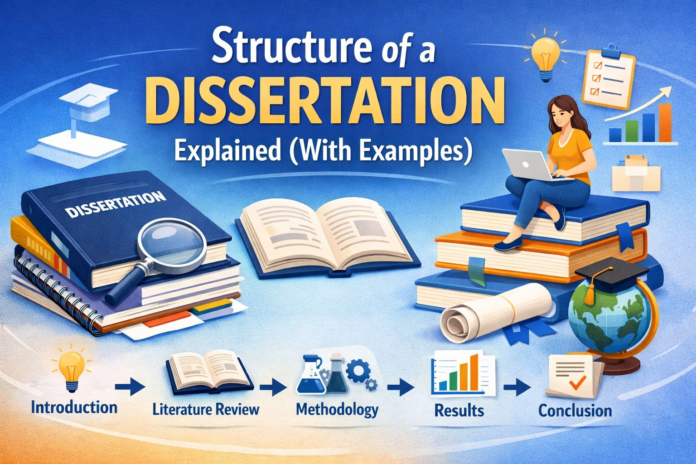
- Introduction
- Literature Review
- Methodology
- Results
- Discussion
- Conclusion
- References
- Appendices
Preliminary Pages Explained
Title Page
The title page is the first impression of your dissertation. It includes:
- Dissertation title
- Your name
- Institution name
- Degree program
- Submission date
Example:
“The Impact of Social Media on Academic Performance: A Study of University Students”
Abstract
The abstract is a brief summary of your dissertation, usually between 150–300 words. It should include:
- Research aim
- Methods used
- Key findings
- Conclusion
Example:
This study examines the impact of social media usage on academic performance among university students. Using a quantitative approach, data was collected through surveys…
Acknowledgements
This section allows you to thank those who supported your research, such as:
- Supervisors
- Family
- Friends
Table of Contents
The table of contents lists all chapters and sections with page numbers, helping readers navigate your dissertation easily.
Main Body of the Dissertation
The main body is the core of your dissertation and contains your research work.
Chapter 1: Introduction
Purpose of the Introduction
The introduction sets the stage for your research. It explains:
- Research topic
- Background information
- Research problem
- Objectives
- Research questions
Example of Introduction
Social media has become an integral part of students’ daily lives. However, its impact on academic performance remains a topic of debate. This study aims to explore…
Chapter 2: Literature Review
What Is a Literature Review?
The literature review analyzes existing research related to your topic. It shows:
- What has already been studied
- Gaps in research
- Theoretical framework
How to Structure It
- Thematic structure
- Chronological structure
- Methodological structure
Example
Previous studies have shown mixed results regarding social media usage. While some researchers argue that it enhances collaboration…
Chapter 3: Methodology
Purpose of Methodology
This chapter explains how you conducted your research. It includes:
- Research design
- Data collection methods
- Sampling techniques
- Data analysis methods
Example
This study used a quantitative research design. Data was collected through online surveys distributed to 200 university students…
Chapter 4: Results
Presenting Your Findings
The results chapter presents your data without interpretation. It may include:
- Tables
- Charts
- Graphs
Example
The results indicate that 65% of students spend more than 3 hours daily on social media…
Chapter 5: Discussion
Interpreting the Results
In this chapter, you explain what your findings mean and relate them to previous research.
Example
The findings suggest that excessive social media usage negatively impacts academic performance, supporting previous studies…
Chapter 6: Conclusion
Summarizing the Study
The conclusion summarizes your research and includes:
- Key findings
- Implications
- Limitations
- Recommendations
Example
This study concludes that while social media can be beneficial, excessive use may hinder academic success…
End Matter of the Dissertation
References
Importance of Referencing
The references section lists all sources used in your dissertation. Common styles include:
- APA
- Harvard
- MLA
Appendices
What to Include
Appendices contain supplementary material such as:
- Questionnaires
- Raw data
- Interview transcripts
Tips for Structuring Your Dissertation
Follow University Guidelines
Always check your institution’s requirements, as formatting rules may vary.
Maintain Logical Flow
Ensure each chapter connects smoothly to the next.
Use Clear Headings
Headings improve readability and organization.
Stay Consistent
Use consistent formatting, font, and citation style throughout.
Common Mistakes to Avoid
Poor Organization
Avoid placing information in the wrong sections.
Lack of Clarity
Ensure your writing is clear and easy to understand.
Ignoring Guidelines
Failure to follow university guidelines can result in lower grades.
Why the Structure of a Dissertation Matters
The structure of a dissertation plays a crucial role in academic success. A well-organized dissertation:
- Improves readability
- Enhances clarity
- Demonstrates professionalism
- Helps examiners evaluate your work effectively
Without proper structure, even strong research can lose its impact.
Final Thoughts
Mastering the structure of a dissertation explained (with examples) is essential for producing a high-quality academic paper. By following the standard format and understanding the purpose of each section, you can present your research clearly and confidently. Remember, a well-structured dissertation not only improves your chances of achieving higher grades but also reflects your academic skills and dedication.
Take your time to plan, organize, and review each section carefully. With the right approach, writing a dissertation becomes a manageable and rewarding process.

