



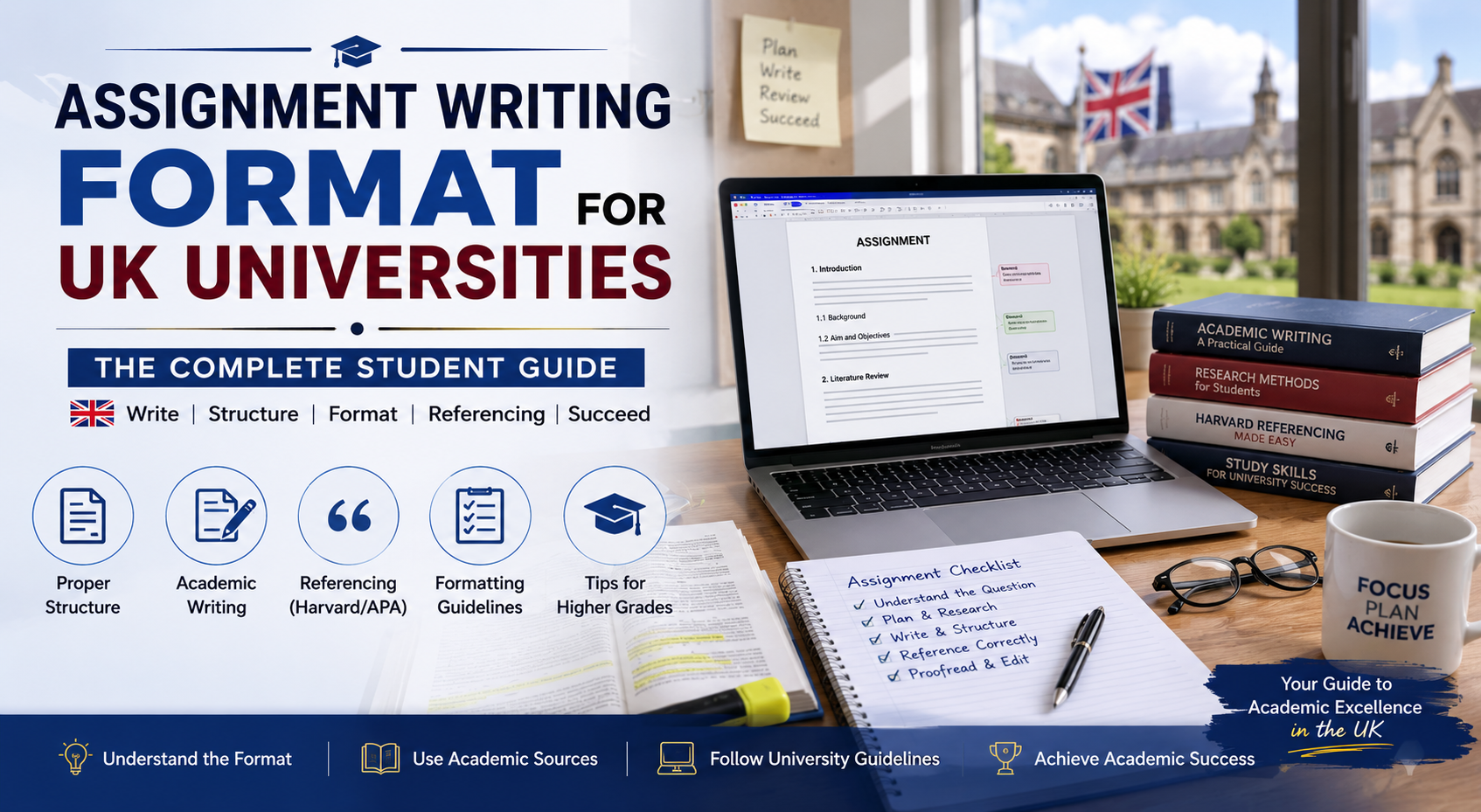
Assignment Writing Format for UK Universities: The Complete Student Guide Academic assignments are a major part of university life in the UK. Whether you are studying at undergraduate or postgraduate level, understanding the correct assignment writing format is essential for achieving high grades. Many students struggle not because they lack knowledge of the subject, but because they fail to present their work according to university standards. Essay Writing Assignments
UK universities expect assignments to follow a clear academic structure, proper formatting guidelines, and accurate referencing styles. A well-formatted assignment demonstrates professionalism, improves readability, and helps lecturers evaluate your work effectively. More importantly, it shows that you understand academic writing conventions.
In this complete guide, you will learn everything about assignment writing formats for UK universities, including structure, formatting rules, referencing styles, proofreading tips, and common mistakes to avoid. By the end of this article, you will feel more confident about preparing assignments that meet academic standards and impress your professors.
Why Assignment Formatting Matters in UK Universities
Many students underestimate the importance of formatting. However, presentation plays a significant role in academic writing. Lecturers often assess not only your ideas but also how clearly and professionally those ideas are presented.
A properly formatted assignment helps organize your arguments logically. It makes your work easier to read and demonstrates attention to detail. In UK universities, assignments that ignore formatting guidelines may lose marks even if the content is strong.
Good formatting also helps avoid plagiarism issues because proper referencing gives credit to original authors. Universities in the UK take academic integrity seriously, and students must follow strict citation standards.
How to Write a Dissertation Abstract & Introduction That Impresses Examiners
Understanding the Standard Assignment Structure
Most UK university assignments follow a similar structure. Although requirements may vary depending on the subject and institution, the following format is widely accepted.
Title Page
The title page creates the first impression of your assignment. It should look clean and professional. Usually, it includes:
- Assignment title
- Student name and ID
- Course name
- Module code
- Lecturer’s name
- Submission date
- University name
Always check your university guidelines because some institutions require anonymous submissions without student names.
Writing the Introduction
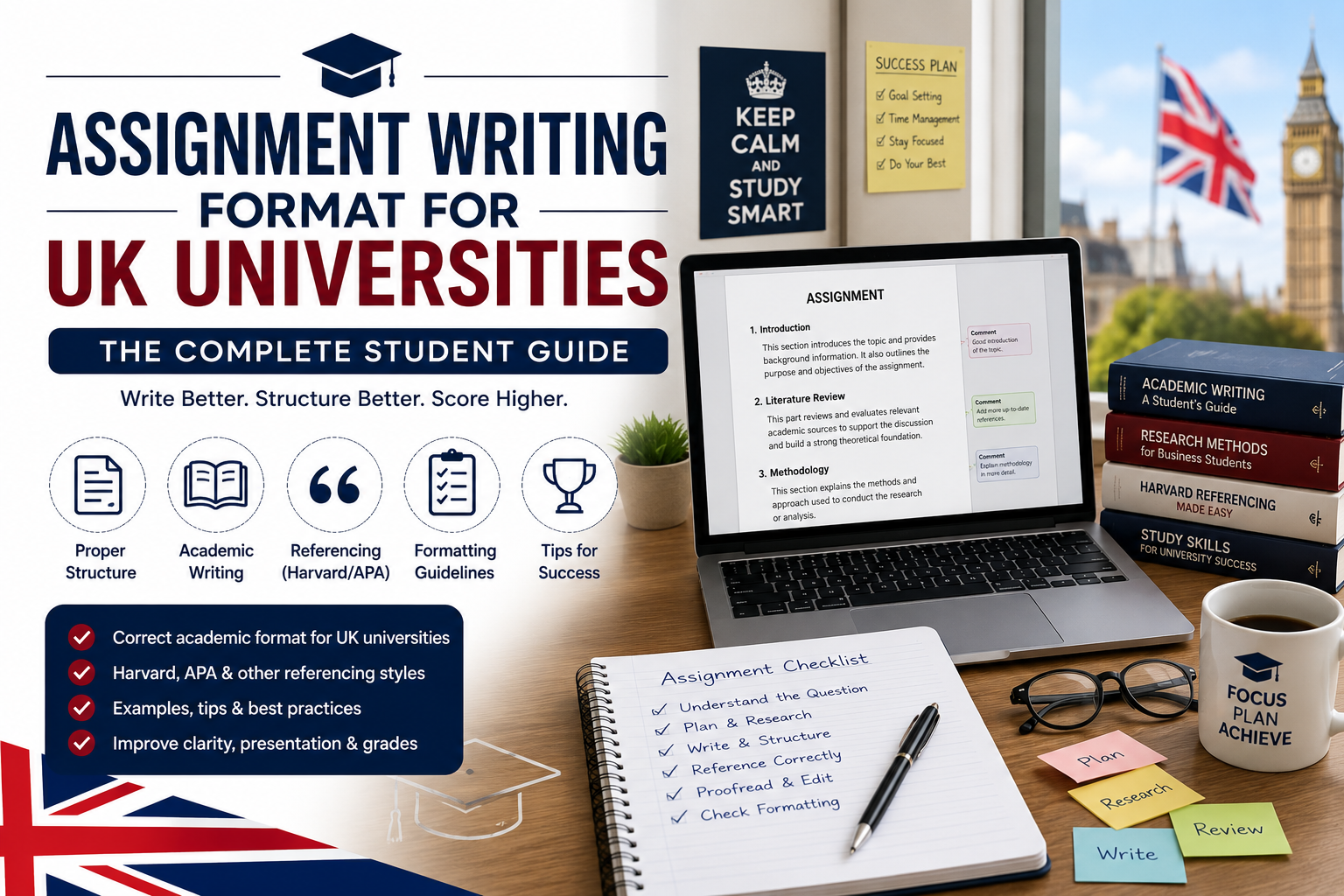
The introduction explains what your assignment is about and what readers can expect. A strong introduction provides background information, defines the topic, and presents the main argument or objective.
An effective introduction should:
- Introduce the topic clearly
- Explain why the topic matters
- Outline the purpose of the assignment
- Briefly mention the structure of the paper
Avoid making the introduction too long. Usually, it should represent around 10% of the total word count.
For example, if you are writing a business assignment, your introduction may explain the importance of leadership strategies and state that the paper will analyze different leadership models used in modern organizations.
Developing the Main Body
The main body is the most important section of your assignment because it contains your analysis, arguments, evidence, and discussion.
Each paragraph should focus on one main idea. Begin with a topic sentence, explain the idea clearly, provide evidence or examples, and then connect it back to your argument.
Use Clear Headings and Subheadings
UK universities encourage students to use headings and subheadings where appropriate. This improves readability and helps structure complex discussions. Online Essay Writing
For example:
- Literature Review
- Research Methods
- Analysis
- Discussion
- Findings
Using headings correctly also improves SEO readability if your work is published online.
Supporting Your Arguments with Evidence
Academic writing must be evidence-based. This means your arguments should be supported by reliable academic sources such as:
- Journal articles
- Books
- Government reports
- Academic databases
- Peer-reviewed research
Avoid relying on unreliable websites or personal opinions. Lecturers expect students to demonstrate critical thinking by engaging with scholarly material.
When presenting evidence, explain its relevance rather than simply inserting quotations. Analysis is more important than description.
Writing a Strong Conclusion
The conclusion summarizes the main points of your assignment without introducing new information. It should restate the main argument and provide a final evaluation of the topic.
A good conclusion should:
- Summarize key findings
- Reinforce the central argument
- Provide final insights or recommendations
- End confidently
Many students make the mistake of repeating the introduction word-for-word. Instead, synthesize your discussion naturally.
Assignment Formatting Guidelines for UK Universities
Formatting rules may vary slightly, but most UK universities follow standard academic conventions.
Font and Font Size
The most commonly accepted fonts include:
- Times New Roman
- Arial
- Calibri
The standard font size is usually 12 points for the main text.
Line Spacing and Margins
Most universities require:
- 1.5 or double line spacing
- Standard 1-inch margins
- Left-aligned text
Proper spacing improves readability and allows lecturers to add comments.
Page Numbers
Always include page numbers, usually in the top-right or bottom-right corner. Missing page numbers can make assignments appear incomplete.
Word Count
Students must stay within the required word limit. Exceeding the limit significantly may lead to penalties.
As a general rule:
- Stay within 10% above or below the word count
- Exclude references unless instructed otherwise
Referencing Styles Used in UK Universities
Referencing is one of the most important parts of academic writing. Different departments use different citation styles.
Harvard Referencing
Harvard is the most common referencing style in UK universities. It uses in-text citations with the author’s surname and publication year.
Example:
(Smith, 2024)
The reference list appears at the end of the assignment in alphabetical order.
APA Referencing
APA is commonly used in psychology, education, and social sciences. It is similar to Harvard but has specific formatting rules for journals, books, and online sources UK Universities.
MLA and Chicago Styles
Humanities subjects may use MLA or Chicago referencing styles. Always confirm your required format before starting your assignment UK Universities.
Proper referencing helps avoid plagiarism and strengthens the credibility of your work.
You can also read our guide on How to Avoid Plagiarism in Academic Writing for more support UK Universities.
Common Assignment Writing Mistakes Students Should Avoid
Many students lose marks because of avoidable errors. Understanding these mistakes can help improve your academic performance UK Universities.
Poor Structure
Assignments without clear organization confuse readers and weaken arguments. Use logical headings and smooth transitions between paragraphs UK Universities.
Weak Academic Sources
Using blogs or unreliable websites reduces academic credibility. Focus on peer-reviewed journals and university-approved sources UK Universities.
Lack of Critical Analysis
UK universities value critical thinking. Simply describing information is not enough. You should compare ideas, evaluate evidence, and discuss different perspectives UK Universities.
Grammar and Spelling Errors
Small language mistakes can affect readability and professionalism. Always proofread your work carefully before submission UK Universities.
Incorrect Referencing
Improper citations may result in plagiarism concerns. Use referencing tools or university guides to ensure accuracy UK Universities.
Tips to Improve Your Assignment Writing Skills
Improving academic writing takes practice, but a few strategies can make the process easier UK Universities.
Start Early
Avoid last-minute writing. Starting early gives you time for research, drafting, and editing UK Universities.
Create an Assignment Plan
Before writing, outline your ideas and organize your sections logically. Planning improves flow and clarity UK Universities.
Read Academic Sources Regularly
Reading journal articles helps you understand academic tone, structure, and argument development UK Universities.
Edit and Proofread Carefully
Never submit your first draft immediately. Review your grammar, structure, citations, and formatting.
Reading your assignment aloud can help identify awkward sentences or unclear arguments UK Universities.
How to Make Your Assignment More Academic
Students often ask how to sound more academic in their writing. Academic writing should be formal, objective, and evidence-based UK Universities.
To improve academic tone:
- Avoid slang and informal language
- Use precise vocabulary
- Write in clear and concise sentences
- Support claims with evidence
- Maintain logical flow
Instead of writing:
“Lots of students hate exams.”
Write:
“Many students experience anxiety during examinations.”
Small improvements like these make your work appear more professional UK Universities.
The Importance of Proofreading Before Submission
Proofreading is one of the most overlooked stages of assignment writing. Even excellent content can lose marks because of simple mistakes UK Universities.
Before submitting your assignment:
- Check spelling and grammar
- Verify citations and references
- Ensure formatting consistency
- Review headings and page numbers
- Confirm the word count
Using tools like Grammarly can help identify errors, but manual proofreading is still essentia UK Universitiesl.
Online Tools That Can Help with Assignment Writing
Several academic tools can improve writing quality and productivity UK Universities.
Helpful tools include:
- Grammarly for grammar checking
- Zotero for reference management
- Google Scholar for academic research
- Turnitin for plagiarism checking
- Microsoft Word Editor for proofreading
These tools support academic writing, but students should still develop their own writing skills UK Universities.
Final Thoughts
Understanding the correct assignment writing format for UK universities is essential for academic success. Strong formatting, proper structure, accurate referencing, and critical analysis all contribute to better grades and a more professional presentation UK Universities.
Many students focus only on content and ignore formatting requirements, but universities expect both strong research and proper academic presentation. By following the guidelines discussed in this article, students can create assignments that are organized, credible, and academically impressive UK Universities.
Remember that academic writing is a skill that improves with practice. The more assignments you write, the more confident and capable you will become. Focus on planning carefully, researching thoroughly, and proofreading consistently UK Universities.
If you want to improve further, you may also explore our detailed guides on dissertation writing, academic research, and essay planning to strengthen your university writing skills.


[…] Assignment Writing Format for UK Universities: The Complete Student Guide […]