



Distinction Grades How to Get Distinction Grades in University Assignments University assignments play a major role in determining academic success. Whether you are studying business, nursing, law, engineering, or social sciences, your assignments reflect your understanding, research abilities, and academic writing skills. Many students work hard but still struggle to achieve distinction grades because they are unaware of what professors truly expect. Distinction Grades
Getting high grades is not only about writing more words or using complex vocabulary. A distinction-level assignment demonstrates critical thinking, strong structure, detailed research, clarity, originality, and proper academic presentation. Students who consistently score distinctions usually follow a proven strategy from planning to proofreading.
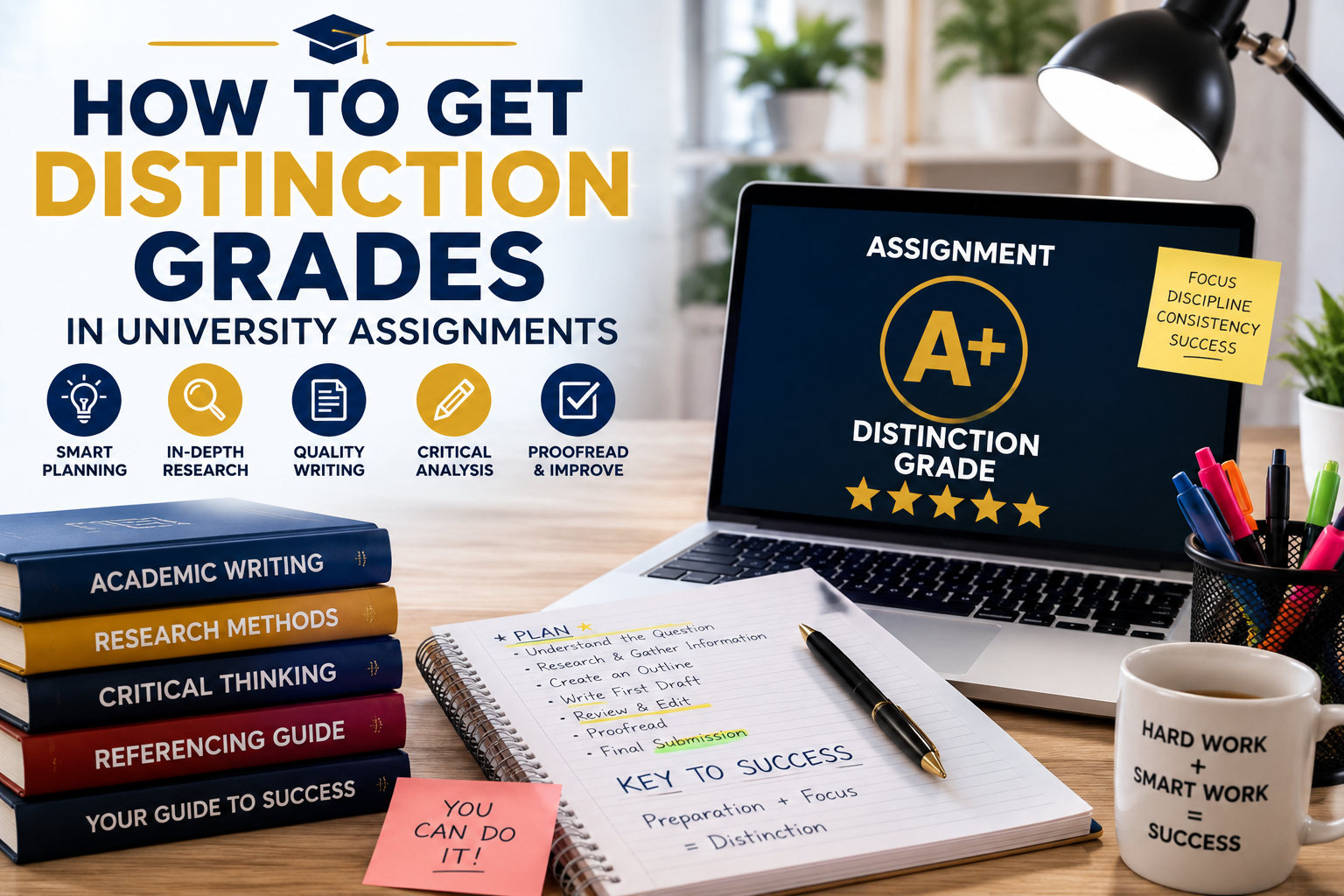
This complete guide explains exactly how to get distinction grades in university assignments. You will learn practical academic writing techniques, research strategies, formatting methods, and common mistakes to avoid so you can improve your grades confidently. Distinction Grades
- Understanding What a Distinction Grade Means
Before improving your assignments, it is important to understand what universities consider a distinction-grade paper. In most universities, distinction-level work demonstrates exceptional understanding of the topic, critical analysis, independent thinking, and excellent presentation. Distinction Grades
A high-quality assignment normally includes:
- Clear understanding of the assignment question
- Strong academic research from reliable sources
- Logical structure and flow
- Critical evaluation instead of simple description
- Accurate referencing and formatting
- Original arguments and insights
- Professional academic language
Professors assess more than just content. They also evaluate how effectively you communicate ideas and support arguments with evidence Distinction Grades.

Complete Guide to Writing an Outstanding University Assignment
Carefully Analyze the Assignment Brief
One of the biggest reasons students lose marks is misunderstanding the assignment requirements. Before starting, spend time carefully reading the assignment brief multiple times Distinction Grades.
Pay close attention to:
- The topic and keywords
- Word count
- Referencing style
- Submission guidelines
- Learning outcomes
- Assessment criteria
For example, if the question asks you to “critically evaluate,” your assignment should analyze strengths and weaknesses rather than simply explain concepts Distinction Grades.
Many students begin writing immediately without proper planning. Instead, break the question into smaller parts and identify exactly what the professor expects Distinction Grades.
A helpful strategy is highlighting instruction words such as Distinction Grades:
- Analyze
- Compare
- Discuss
- Critically evaluate
- Examine
- Assess
These words determine the direction of your assignment Distinction Grades.
Conduct High-Quality Academic Research
Research is the foundation of distinction-grade assignments. Weak or outdated sources reduce credibility and affect grades significantly Distinction Grades.
Use reliable academic sources such as:
- Peer-reviewed journals
- University databases
- Google Scholar
- Academic books
- Government publications
- Research reports
Avoid relying heavily on blogs or random websites unless they are authoritative and relevant Distinction Grades.
When researching, focus on understanding different viewpoints rather than collecting random information. Professors appreciate assignments that demonstrate independent analysis supported by evidence Distinction Grades.
Take organized notes while researching. Record references immediately to avoid citation problems later Distinction Grades.
If possible, include recent studies and statistics because current evidence strengthens academic arguments Distinction Grades. Essay Writing Assignments
Create a Strong Assignment Structure
A well-structured assignment improves readability and makes arguments easier to follow. Even excellent research can lose marks if presented poorly Distinction Grades.
Most university assignments follow this structure:
Introduction
The introduction should clearly explain:
- The purpose of the assignment
- Main argument or thesis statement
- Key areas you will discuss
Avoid overly broad openings. Keep the introduction focused and direct.
A strong introduction immediately creates a professional impression.
Main Body
The body paragraphs form the core of your assignment. Each paragraph should discuss one main idea supported by evidence and examples.
A useful paragraph structure is:
- Topic sentence
- Evidence or example
- Analysis
- Link to the main argument
Avoid writing long paragraphs without clear direction. Short, focused paragraphs improve readability and engagement.
Distinction-level assignments usually include critical analysis instead of simple descriptions. This means discussing: Online Essay Writing
- Strengths and weaknesses
- Different perspectives
- Real-world implications
- Comparisons between theories
- Limitations of research
Critical thinking is often what separates average assignments from distinction-grade work.
Conclusion
The conclusion should summarize your main findings without introducing new ideas.
A good conclusion:
- Restates the main argument
- Highlights key insights
- Provides a final academic observation
Keep it concise but meaningful Distinction Grades.
Improve Your Academic Writing Style
Strong academic writing is clear, professional, and precise. Many students mistakenly believe complicated vocabulary guarantees high marks, but clarity is more important.
To improve your writing:
- Use formal academic language
- Avoid slang and informal phrases
- Write in active voice when appropriate
- Keep sentences concise
- Use transition words for smooth flow
Examples of useful transition words include:
- Furthermore
- However
- In contrast
- Therefore
- Consequently
- Similarly
Your assignment should sound confident and analytical.
Avoid repetitive wording and unsupported claims. Every important statement should be supported with evidence or references Distinction Grades.
Focus on Critical Thinking
Critical thinking is one of the most important factors in achieving distinction grades.
Many average assignments simply describe information from sources. High-scoring assignments go further by evaluating and questioning ideas Distinction Grades.
For example, instead of writing:
“Social media affects students.”
You could write:
“Although social media improves communication and collaboration among students, excessive use may negatively affect academic performance and concentration.”
This demonstrates balanced analysis and deeper understanding.
Professors value students who can:
- Analyze evidence
- Compare viewpoints
- Challenge assumptions
- Develop independent arguments
Critical thinking transforms basic assignments into outstanding academic work Distinction Grades.
Use Proper Referencing and Citations
Incorrect referencing can reduce marks significantly and may even lead to plagiarism issues Distinction Grades.
Always follow the required referencing style, such as:
- Harvard
- APA
- MLA
- Chicago
Ensure every source cited in the text appears in the reference list.
Accurate referencing demonstrates professionalism and academic integrity.
Helpful referencing tools include:
- Zotero
- Mendeley
- EndNote
However, always double-check automatically generated citations because software can make formatting errors Distinction Grades.
Avoid Common Assignment Mistakes
Many students lose easy marks because of avoidable mistakes.
Common problems include:
Weak Thesis Statements
Your main argument should be clear and specific from the beginning.
Poor Time Management
Starting assignments late often results in rushed work and weak analysis.
Begin early so you have enough time for research, writing, and editing.
Lack of Evidence
Unsupported opinions weaken academic credibility Distinction Grades.
Always support arguments with reliable evidence and references.
Ignoring Feedback
Previous feedback from professors is extremely valuable. Review comments from past assignments and identify recurring weaknesses.
Poor Proofreading
Grammar and spelling mistakes create an unprofessional impression.
Always proofread carefully before submission.
Master Time Management for Better Grades
Good time management is essential for academic success. Students who plan effectively usually produce higher-quality assignments with less stress Distinction Grades.
A practical approach is dividing the assignment process into stages:
| Task | Suggested Time |
|---|---|
| Understanding the topic | 10% |
| Research | 30% |
| Planning | 10% |
| Writing | 40% |
| Editing and proofreading | 10% |
Avoid writing the entire assignment in one sitting. Working in stages improves focus and quality.
Using calendars or productivity apps can help students stay organized and meet deadlines consistently.
Edit and Proofread Like a Professional
Editing is where distinction-level assignments are refined. Even excellent first drafts require revision .Distinction Grades
During editing, check:
- Grammar and spelling
- Sentence clarity
- Structure and flow
- Referencing accuracy
- Repetition
- Word count compliance
Reading your assignment aloud helps identify awkward sentences and unclear sections.
It is also useful to take a short break before proofreading because fresh eyes catch more mistakes.
If possible, ask a friend or professional proofreader to review your work.
Understand What Professors Really Want
Many students focus only on completing assignments rather than understanding assessment expectations.
Most professors look for: Distinction Grades.
- Clear understanding of the topic
- Original thinking
- Evidence-based arguments
- Strong organization
- Professional presentation
- Accurate referencing
- Critical analysis
Your goal should not simply be answering the question but demonstrating academic maturity and analytical skills.
Think of your assignment as a professional academic discussion rather than a basic homework task.
Use Feedback to Continuously Improve
Every assignment provides an opportunity to improve future performance.
Instead of focusing only on grades, carefully analyze professor feedback.
Identify patterns such as:
- Weak analysis
- Poor referencing
- Lack of clarity
- Insufficient evidence
Students who actively apply feedback Distinction Grades often improve dramatically over time.
Keeping a record of feedback can help you avoid repeating mistakes in future assignments.
How Online Essay Writing Support Can Help
Sometimes students struggle because of workload pressure, language barriers, or lack of confidence in academic writing.
Professional academic guidance can help students:
- Understand assignment requirements
- Improve structure and formatting
- Learn proper referencing
- Enhance proofreading quality
- Develop stronger arguments
At Online Essay Writing, Distinction Grades students can access expert guidance, editing support, and academic writing assistance designed to improve overall performance and confidence.
You may also find these helpful resources useful:
- How to Improve Academic Writing Skills
- Complete Guide to Essay Structure
- Best Referencing Tips for University Students
Internal linking between related academic resources improves both user experience and SEO performance.
Final Thoughts
Achieving distinction grades in Distinction Grades university assignments is possible when students combine strong research, critical thinking, clear structure, and effective academic writing techniques.
Success does not come from last-minute effort or complicated vocabulary. It comes from understanding the assignment requirements, planning carefully, using reliable research, and presenting ideas professionally.
The students who consistently achieve high grades are usually those who approach assignments strategically rather than emotionally. They manage time effectively, revise carefully, and continuously improve through feedback.
By applying the strategies discussed in this guide, you can significantly improve the quality of your assignments and increase your chances of achieving distinction-level results throughout your academic journey. Distinction Grades.
Remember that academic writing is a skill that improves with practice. Every assignment is an opportunity to become a stronger, more confident university student.


[…] 10 Tips to Get Distinction Grades in Assignments […]