


Introduction to Digital Marketing Trends in 2026
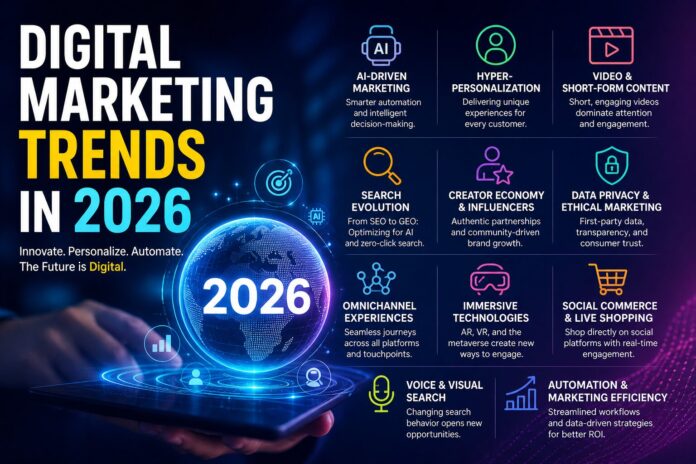
Digital marketing trends in 2026 are evolving at an unprecedented pace, driven by rapid advancements in artificial intelligence, changing consumer behavior, and the rise of new digital platforms. Businesses are no longer competing solely on products or services but on the experiences they create for their audiences. In this dynamic environment, understanding the latest digital marketing trends in 2026 is essential for staying competitive and relevant. From AI-powered automation to hyper-personalization and immersive experiences, the marketing landscape has transformed into a highly intelligent and customer-centric ecosystem. Companies that adapt to these trends will not only improve engagement but also achieve sustainable growth in an increasingly crowded digital marketplace.
The Rise of AI-Driven Marketing
AI as the Core of Digital Marketing
Artificial intelligence has become the backbone of digital marketing trends in 2026. It is no longer just a tool for automation but a strategic driver that influences decision-making, campaign optimization, and customer engagement. Marketers are now leveraging AI to analyze massive datasets, predict consumer behavior, and create highly targeted campaigns in real time. This is where professional services like Essay Writing Assignments become invaluable.
Agentic Marketing and Automation
One of the most significant developments is the emergence of “agentic marketing,” where AI systems can independently plan, execute, and optimize campaigns. These systems reduce manual effort and allow marketers to focus on strategy and creativity. This shift marks a transition from traditional automation to autonomous marketing ecosystems that operate with minimal human intervention.
Hyper-Personalization Becomes the Standard
From Personalization to Individualization
Digital marketing trends in 2026 emphasize hyper-personalization, where each customer experiences a unique journey tailored to their preferences, behavior, and interactions. Brands are using first-party and zero-party data to create meaningful connections and deliver relevant content at every touchpoint. Students also read about study techniques that improve academic performance.
Impact on Customer Experience
Consumers now expect brands to understand their needs without explicitly stating them. Personalized recommendations, dynamic content, and AI-driven messaging significantly enhance user experience and increase conversion rates. Studies show that personalized marketing strategies lead to higher customer satisfaction and brand loyalty.
The Dominance of Video and Short-Form Content
Video-First Marketing Strategies
Video content continues to dominate digital marketing trends in 2026, with platforms prioritizing visual storytelling over traditional text-based content. Short-form videos, in particular, have become a powerful tool for capturing attention and driving engagement.
Growth of Short-Form Platforms
Platforms like Instagram Reels, YouTube Shorts, and TikTok are shaping how users consume content. Short-form videos account for a significant portion of user engagement, making them essential for any marketing strategy.
Evolution of Search: From SEO to GEO
AI-Driven Search Experiences
Search behavior has drastically changed in digital marketing trends in 2026. Traditional search engine optimization (SEO) is evolving into generative engine optimization (GEO), where content must be optimized for AI-generated answers rather than just search rankings.
Zero-Click Searches and Visibility
Zero-click searches are becoming more common, where users get answers directly from search engines without visiting websites. This shift requires marketers to focus on creating structured, high-quality content that can be featured in AI summaries.
The Creator Economy and Influencer Marketing
Rise of Micro and Nano Influencers
The creator economy continues to grow, with brands increasingly collaborating with micro and nano influencers who offer authentic and niche audiences. These influencers often generate higher engagement compared to traditional celebrities.
Long-Term Creator Partnerships
Brands are moving away from one-off influencer campaigns and focusing on long-term partnerships that build trust and credibility. Authentic storytelling and genuine connections are now key factors in successful influencer marketing strategies.
Data Privacy and Ethical Marketing
Shift to First-Party Data
With increasing regulations and the decline of third-party cookies, digital marketing trends in 2026 emphasize the importance of first-party and zero-party data. Businesses must collect and use data responsibly while maintaining transparency with consumers.
Ethical Marketing Practices
Ethics and sustainability are becoming integral to marketing strategies. Consumers are more likely to engage with brands that demonstrate social responsibility and prioritize data privacy.
Omnichannel and Multi-Platform Marketing
Seamless Customer Journeys
Digital marketing trends in 2026 highlight the importance of omnichannel strategies that provide a seamless experience across multiple platforms. Customers interact with brands through various channels, including social media, websites, apps, and offline touchpoints.
Integration of Marketing Channels
Successful marketers integrate all channels into a unified strategy, ensuring consistent messaging and branding. This approach enhances customer engagement and improves overall campaign performance.
Immersive Technologies: AR, VR, and Metaverse
Enhanced Customer Experiences
Augmented reality (AR) and virtual reality (VR) are transforming how consumers interact with brands. These technologies provide immersive experiences that allow customers to visualize products before making a purchase.
The Role of the Metaverse
The metaverse is emerging as a new marketing frontier, offering opportunities for brands to engage with audiences in virtual environments. Although still developing, it represents a significant trend in digital marketing trends in 2026.
Content Marketing Evolution
Quality Over Quantity
In 2026, content marketing focuses on quality rather than quantity. Brands are prioritizing valuable, informative, and engaging content that resonates with their audience.
Human-Centric Storytelling
Despite the rise of AI, human creativity and storytelling remain essential. Successful marketing campaigns combine data-driven insights with emotional storytelling to create meaningful connections with consumers.
Automation and Marketing Efficiency
Streamlining Marketing Processes
Automation tools are helping marketers streamline repetitive tasks such as email campaigns, social media posting, and data analysis. This increases efficiency and allows teams to focus on strategic initiatives.
Improved ROI and Performance
By leveraging automation, businesses can optimize their marketing budgets and achieve better results. AI-driven tools enable real-time adjustments, ensuring campaigns deliver maximum impact.
The Importance of Brand Authenticity
Building Trust in a Digital World
Authenticity is a critical factor in digital marketing trends in 2026. Consumers are more likely to trust brands that are transparent, genuine, and consistent in their messaging.
Community-Driven Marketing
Brands are increasingly focusing on building communities rather than just selling products. Engaging with customers and fostering relationships leads to long-term loyalty and advocacy.
Social Commerce and Shoppable Content
Integration of Shopping and Social Media
Social commerce is transforming the way consumers shop online. Platforms now offer integrated shopping experiences, allowing users to purchase products directly within apps.
Growth of Live Shopping
Live shopping events and interactive content are gaining popularity, providing real-time engagement and boosting sales. This trend is expected to continue growing in digital marketing trends in 2026.
Voice and Visual Search
Changing Search Behaviors
Voice and visual search are becoming mainstream, changing how users find information online. Marketers must optimize their content for conversational queries and image-based searches.
Opportunities for Businesses
These technologies provide new opportunities for businesses to reach audiences in innovative ways. Optimizing for voice and visual search can improve visibility and drive traffic.
Future Challenges in Digital Marketing
Adapting to Rapid Changes
One of the biggest challenges in digital marketing trends in 2026 is keeping up with constant changes. Marketers must continuously learn and adapt to new technologies and strategies.
Balancing Automation and Creativity
While automation offers efficiency, maintaining creativity and human touch is essential for successful marketing campaigns. Striking the right balance is key to achieving long-term success.
Conclusion:
The Future of Digital Marketing Trends in 2026
Digital marketing trends in 2026 highlight a shift toward intelligent, personalized, and immersive marketing strategies. AI-driven tools, hyper-personalization, video content, and ethical practices are shaping the future of the industry. Businesses that embrace these trends and focus on delivering value to their customers will thrive in the competitive digital landscape. As technology continues to evolve, marketers must remain flexible, innovative, and customer-focused to stay ahead of the curve. Ultimately, the success of digital marketing in 2026 depends on the ability to combine advanced technology with authentic human connections, creating experiences that resonate with audiences and drive meaningful results.


[…] Personalization in digital advertising using AI refers to the process of leveraging artificial intelligence technologies to tailor advertisements based on user data such as browsing history, demographics, interests, and online behavior. Unlike traditional advertising methods that rely on generic messaging, AI-driven personalization ensures that each user receives content that is specifically relevant to them. Machine learning algorithms analyze patterns and predict what type of advertisement a user is most likely to engage with, thereby improving the overall effectiveness of marketing campaigns. Students also read about Digital Marketing Trends in 2026. […]
[…] Modern data security relies heavily on encryption techniques such as RSA and ECC (Elliptic Curve Cryptography). These systems depend on the difficulty of solving mathematical problems, such as factoring large numbers. For example, the widely used RSA encryption has been a cornerstone of secure communication for decades. However, its strength is based on the limitations of classical computers. Students are also reading the digital marketing trends in 2026. […]